You’ve bought the cute baskets. Downloaded the organizing apps. Watched countless videos of perfectly arranged pantries and color-coordinated closets. Yet somehow, your home still feels chaotic. Your drawers are still jammed. Your counters are still covered. Here’s the truth nobody wants to admit: you can’t organize your way out of having too much stuff. It is better to stop organizing and start decluttering.
I spent years rearranging the same items over and over, thinking I just hadn’t found the right system yet.
I’d reorganize my bathroom cabinet monthly, shuffle books between different shelves, and buy new containers thinking they’d solve everything. But within weeks, everything looked messy again.
The problem wasn’t my organizing skills. The problem was that I was trying to find homes for things that didn’t deserve space in my life.
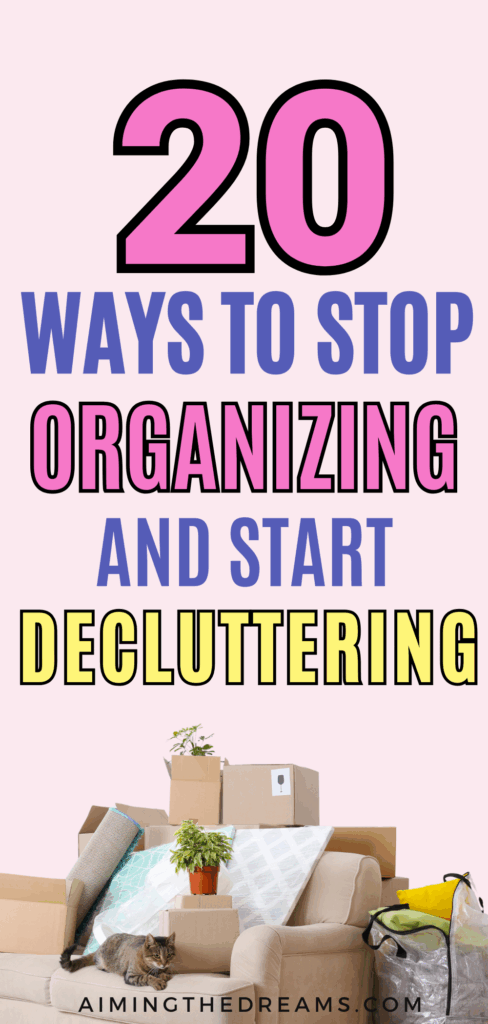
20 Tips to Stop Organizing and Start Decluttering
Stop shuffling stuff around and start letting it go. Here’s how to declutter like you mean it.
1. If you haven’t touched it in a year, you won’t miss it in two.
2. Storage solutions are just pretty ways to hide your clutter problem.
3. When in doubt, toss it out—doubt is your brain telling you it’s not important.
4. One in, two out—every new thing means two old things have to go.
5. If you’re keeping it “just in case,” that case probably isn’t coming.
6. Broken things you’ve been meaning to fix for months aren’t getting fixed.
7. Start with the easy stuff—expired products and obvious trash build momentum.
8. Ask yourself: would I buy this today at full price?
9. Gifts you don’t love aren’t doing anyone any favors sitting in your closet.
10. If organizing feels like work, you own too much stuff.
11. Stop buying containers until you’ve emptied the ones you have.
12. Clothes that don’t fit your current body don’t belong in your current closet.
13. Duplicates are clutter—keep the best one and ditch the rest.
14. If you forgot you owned it, you don’t need to own it.
15. Sentimental doesn’t mean everything—choose your favorites and let go of the rest.
16. Free stuff isn’t free if it costs you space and peace of mind.
17. The goal isn’t perfect organization, it’s having less to organize.
18. If it takes more energy to maintain than it brings you joy, it’s got to go.
19. Your future self will thank you for every decision you make today.
20. The best time to declutter was yesterday—the second best time is right now.
The Organizing Trap We All Fall Into
Organizing feels productive. It feels like progress. You can spend an entire weekend reorganizing your bedroom and feel accomplished, even if you haven’t made your life easier.
However, organizing is simply rearranging things. You’re creating systems to manage abundance rather than addressing the abundance itself. It’s like trying to manage a flood by buying more buckets instead of fixing the leak.
The organizing industry has convinced us that we just need better systems, more bins, better labels, cleverer storage solutions.
However, this creates an endless cycle: buy things, struggle to fit them somewhere, buy organizing products to manage the clutter, repeat.
I fell into this trap hard. I’d reorganize my junk drawer every few months, buying new dividers each time. I’d spend hours arranging books by height, color, or genre.
I’d fold clothes in increasingly elaborate ways, convinced the right folding method would solve everything.
The rush of a freshly organized space is real. It looks clean and intentional.
You take a photo for Instagram. You feel like you’ve accomplished something meaningful.
But within days or weeks, entropy takes over. Items migrate back to their old spots. New stuff accumulates. The system breaks down because it was built to manage too much stuff in the first place.
Think about it this way: if you have 50 t-shirts, you can spend hours figuring out how to organize them. You can buy drawer dividers, fold them perfectly, arrange them by color. But you’ll still need massive amounts of drawer space, and you’ll still waste time digging through them to find what you want.
Or you could declutter down to 15 t-shirts you actually love and wear. Suddenly, organization becomes effortless. Any simple system works when you don’t have too much stuff.
The difference is profound. With 50 shirts, even the best organizing system is complex and fragile. With 15 shirts, you can hang them up and be done, no system required.
How To Organize Your Home Office
Why Decluttering Comes First
Decluttering isn’t about getting rid of everything you own. It’s about being intentional with what you keep. It’s about creating space for the things that matter to you.
When you declutter first, organizing becomes almost automatic. You’re not trying to cram 100 items into space meant for 30. You’re not playing Tetris with your belongings every time you put something away.
I learned this lesson the hard way in my kitchen. I had gadgets stuffed into every drawer and cabinet. A pasta maker I’d used twice. Three different types of can openers. Specialty tools for foods I never actually cooked. I’d bought organizers and tried different arrangements, but cooking still felt stressful because I could never find what I needed quickly.
The breakthrough came when I stopped trying to organize everything and started questioning whether I needed it all. Did I really need that avocado slicer when a knife worked just fine? Was I ever going to use that bread maker taking up half my counter?
Then I got ruthless. I kept the tools I used regularly and donated the rest. My kitchen went from chaotic to calm overnight. Suddenly, I no longer needed complicated organizing systems.
Everything had a prominent place, and I could grab what I needed without digging.
However, what surprised me most was that cooking became more enjoyable. Without visual clutter competing for my attention, I could focus on the actual process. I wasn’t overwhelmed by choices or frustrated by messy drawers.
The same principle applies everywhere. Your closet doesn’t need a complex color-coding system if you only keep clothes you wear.
Your bathroom doesn’t require elaborate storage solutions if you’re not hoarding expired products and samples you’ll never use.
When you own less, everything has room to breathe. Drawers close easily. Shelves aren’t overcrowded. You can see what you have at a glance.
The Mental Shift That Changes Everything
Most of us have been conditioned to think more stuff equals more options, which equals more happiness. We hold onto things “just in case” or because they might be useful someday.
We keep items because we paid good money for them, even if we never use them.
This scarcity mindset runs deep. What if I need this someday? What if I regret getting rid of it? What if I can’t find another one like it?
But here’s what I’ve discovered through years of trial and error: having fewer, better things gives you more freedom. You spend less time managing your stuff and more time enjoying your life.
This mental shift is crucial, and it’s often the most challenging part of the process. Instead of asking “Where can I put this?” start asking “Do I need this in my life?”
Instead of “How can I organize these 30 coffee mugs?” ask “How many coffee mugs do I realistically use?” (Spoiler alert: probably two or three, unless you regularly host large dinner parties.)
Instead of “What organizing system will hold all these books?” consider “Which of these books am I actually going to read again?” Be honest here.
That business book from 2018 that you highlighted but never implemented? The novel you struggled to finish? The cookbook you’ve never cooked from?
This isn’t about deprivation. It’s about being honest with yourself about what you actually use and value versus what you think you should keep.
I used to keep every card and letter anyone had ever given me. I reasoned that they represented memories and relationships. But when I looked through them, most sparked no particular joy or recollection.
They were just paper, taking up space. The significant ones, maybe 10% of the total, I kept. The rest were just obligation clutter.
The same logic applies to clothes that don’t fit, books you’ll never reread, and kitchen gadgets you bought with good intentions but never use.
Keeping them doesn’t honor the money you spent or the person who gave them to you. It just creates daily friction in your life.
Where Most People Go Wrong
The biggest mistake people make is trying to organize and declutter simultaneously.
They’ll start sorting through a closet, get overwhelmed by all the decisions, and end up just rearranging everything back into the space.
Or they’ll declutter a little bit, then immediately start organizing what’s left, without truly evaluating whether they need everything they kept.
Here’s a better approach: declutter ruthlessly first, then organize the remaining items.
Don’t worry about organization systems until you know precisely what you’re keeping.
Another common mistake is decluttering room by room instead of category by category. If you have books in your bedroom, living room, and office, tackle them all at once.
Gather them in one place so you can see exactly how many you have and make better decisions about what to keep.
The Decluttering Process That Actually Works
Start with the easiest category first. For most people, that’s clothes, but for you, it might be books, kitchen gadgets, or toiletries.
Choose something that doesn’t have high emotional attachment – save the photo albums and family heirlooms for later when you’ve built up your decision-making skills.
Pull everything out of your closet and drawers.
Yes, everything. Put it all in one place – your bed works well because it forces you to deal with it before you can sleep.
Now comes the important part: don’t think about where you’ll put things. Don’t worry about organizing systems. Just focus on what you want to keep in your life.
Pick up each item and ask yourself: Do I feel good when I wear this? Does it fit my current lifestyle? Would I buy this today if I saw it in a store?
Be honest. That shirt you haven’t worn in two years but keep “just in case” you need something “fancy” for an undefined future event? You probably don’t need it. Those jeans that don’t quite fit but you’re hoping will someday? They’re taking up mental and physical space while making you feel bad about your body.
Here’s a trick that helped me: imagine you’re moving across the country and have to pay to ship everything. What would you actually pay to keep?
That expensive dress you never wear becomes a lot less valuable when you think about it taking up space in a moving truck.
For sentimental items, ask yourself if the item truly brings back good memories or if you’re keeping it out of guilt.
That sweater your grandmother knitted that you never wear because it’s itchy and unflattering? Honor your grandmother by keeping one meaningful item and letting go of the obligation pieces.
Keep only the things you genuinely like and use.
Not the things you think you should like, or the things you paid a lot of money for, or the things that might be useful in some imaginary future scenario.
This process gets easier with practice. The first time, you might agonize over every decision. By the third or fourth category, you’ll develop a better sense of what truly adds value to your life and what merely takes up space.
Once you’ve decided what to keep, you can think about how to organize it.
But you’ll probably find that the organization becomes much simpler when you have less stuff. You might not even need special organizing products – just some basic hangers and maybe a few simple bins.
Why This Approach Saves You Time and Money
When you declutter first, you avoid buying organizing products you don’t need.
I can’t tell you how much money I wasted on containers and systems that didn’t solve the real problem. Drawer organizers for drawers stuffed with things I never used.
Shoe racks for shoes I never wore. Closet systems are designed to maximize storage when what I needed was less stuff to store.
The organizing industry wants you to believe you need their products to have a functional home. But most organizing problems disappear when you address the volume issue first.
You don’t need a complex spice rack system if you only keep spices that you use in cooking. You don’t need elaborate bathroom storage if you’re not hoarding expired products and sample sizes.
You also save time in the long run. Less stuff means less to clean, maintain, and organize. Think about how much time you spend looking for things in overstuffed drawers and closets.
When everything has a clear, uncrowded home, you can find what you need in seconds instead of minutes.
I used to spend at least 10 minutes every morning looking for something to wear, digging through packed drawers and overflowing closets.
Now I spend maybe 30 seconds because everything in my closet fits me, fits my lifestyle, and goes together reasonably well.
The same thing happened in my kitchen. When I had dozens of gadgets and appliances, I’d waste time moving things around to find what I needed.
Now I can grab any tool instantly because everything has a logical, accessible place.
And here’s something interesting: when you own fewer things, you tend to take better care of what you have.
You’re more likely to put things back where they belong because the system isn’t overcrowded and overwhelming.
There’s also a psychological benefit to having less stuff: decision fatigue decreases dramatically. When you have 50 t-shirts, choosing what to wear becomes a complex decision.
When you have 15 shirts you love, the choice is easy. This applies to everything from what to cook (fewer ingredients to choose from) to what to read (a curated book collection instead of an overwhelming library).
Making Decluttering Less Overwhelming
The key is to start small and build momentum. Don’t try to declutter your entire house in a weekend – that’s a recipe for burnout and giving up halfway through.
Pick one category to focus on completely before moving to the next. Maybe start with something manageable like socks and underwear, or books, or kitchen gadgets.
The goal is to build your decision-making muscles and experience some wins before tackling more emotionally challenging categories.
Set a timer if it helps. Even 15 minutes of focused decluttering can make a noticeable difference.
You’d be surprised how much you can accomplish in a short burst of concentrated effort.
Create three distinct piles: keep, donate, and trash. Don’t create a “maybe” pile, that’s just procrastination disguised as organization. Force yourself to decide each item. Trust your gut instinct; it’s usually right.
Remember that decluttering is a skill that gets easier with practice. The first few times, you might agonize over every decision. Should I keep this sweater I haven’t worn in a year?
What about this book? I might want to reference it someday. However, as you become more adept at identifying what you value and use, the process becomes faster and more intuitive.
One helpful strategy is to flip the question. Instead of asking “Should I get rid of this?” ask “Do I want to keep this?” The shift in perspective makes it easier to be honest about what deserves space in your life.
For items you’re unsure about, try the box test. Put questionable items in a box and store it somewhere out of the way.
If you don’t go looking for anything in that box within six months, consider donating the whole thing without even opening it. You’ll be surprised how rarely you miss anything.
Don’t aim for perfection. Aim for improvement. Your goal isn’t to live like a minimalist if that doesn’t appeal to you.
Your goal is to keep only the things that serve your actual life, not some imaginary version of yourself.
The Ripple Effect of Decluttering
Once you experience the relief of having less stuff to manage, it becomes addictive in the best way possible.
You start noticing how much mental energy you were spending on managing your belongings – energy that’s now available for more important things.
Your home becomes easier to clean because there’s less clutter to move around and fewer surfaces to collect it. You can vacuum a room in half the time when you’re not navigating around piles of things.
You can find things quickly, which reduces daily stress more than you might expect. No more frantically searching for your keys, phone charger, or favorite sweater. Everything has a logical place and enough space to be easily visible.
You feel calmer in your space because it’s not visually overwhelming. There’s something profound about walking into a room where everything belongs and nothing is competing for your attention.
Your nervous system can relax.
This calm extends beyond your physical space. When you’re not constantly managing excess stuff, you have more mental bandwidth for relationships, hobbies, and goals that matter to you.
You might even find that you buy less stuff in the future, because you become more aware of the actual cost of ownership. Every item you bring home requires time, energy, and space to maintain.
When you factor in these hidden costs, many purchases become less appealing.
I used to impulse-buy kitchen gadgets, thinking each new tool would make me a better cook. Now I pause and ask myself: Where will this live?
What will I get rid of to make room for it? How often will I realistically use it? These simple questions have saved me hundreds of dollars and kept my kitchen functional.
The ripple effects extend to other areas of life, too.
When an Organization Helps
Don’t get me wrong, organization has its place. But it should come after decluttering, not instead of it.
Once you’ve pared down to what you need and use, simple organizing systems work beautifully. You may need some basic storage solutions, but you won’t require complex systems to manage excess items.
The best organizing systems are usually the simplest ones: a few broad categories, clear labels if needed, and designated homes for everything. When you don’t have too much stuff, almost any reasonable system will work.
For example, my closet organization is currently quite basic. Pants in one section, shirts in another, dresses together. That’s it. No color coding, no seasonal rotation, no complex categorization. It works perfectly because I only kept the clothes I wear.
The same applies to my kitchen, basic categories: cooking tools in one drawer, eating utensils in another, and measuring tools together. No elaborate systems or specialty organizers needed.
Here’s the key insight: an organization should make your life easier, not create another thing to maintain.
If your organizing system is so complex that you can’t hold it, or if it takes longer to put things away than to find them, you probably still have too much stuff.
Good organization is invisible. You shouldn’t have to think about it or work to maintain it. Things should have obvious homes that make sense to anyone using the space.
This is why I recommend waiting to buy organizing products until after you’ve decluttered completely.
You might discover you don’t need them at all, or you might find that straightforward solutions work better than the elaborate systems you were considering.
Breaking the Cycle for Good
The real goal is to break the cycle of accumulating stuff and then scrambling to organize it. Instead of constantly managing excess, you create systems that prevent excess in the first place.
Before you buy something new, ask yourself three questions: Where will this live? What will I get rid to make room for it? How often will I realistically use this?
These simple questions prevent many impulse purchases and help keep clutter from building up again.
The “one in, one out” rule works well for maintaining what you’ve accomplished. When you buy a new shirt, donate an old one.
I realized I was using shopping as a form of entertainment, browsing stores when I was bored, and buying things I didn’t need just because they were on sale.
Once I recognized this pattern, I found other ways to entertain myself that didn’t involve accumulating stuff.
It also helps to reassess what you own on a regular basis. Every few months, conduct a quick review of various areas and remove items that are no longer serving you. This prevents the gradual creep of clutter that happens when we stop paying attention.
Create boundaries for different categories. Maybe you decide you’ll never own more than 30 books at a time, or you’ll limit yourself to one set of sheets per bed. Having clear limits makes it easier to say no to things that would push you over those boundaries.
The goal isn’t to never repurchase anything. It’s to be intentional about what you bring into your space and life.
When you buy things deliberately rather than impulsively, you end up with possessions that truly serve you.
17 Decluttering Tips For Messy People
The Freedom on the Other Side
Living with less stuff doesn’t mean living with less joy. It means surrounding yourself only with things that actually add value to your life.
Your home becomes a place that supports you, rather than overwhelming you. You spend less time managing your belongings and more time doing things you enjoy.
You have space, both physical and mental, to focus on what matters most.
This isn’t about achieving some Instagram-perfect minimalist aesthetic with white walls and three pieces of furniture. It’s about creating an environment that feels good to you and supports your actual lifestyle.
Maybe for you that means a cozy reading nook with your favorite books, not every book you’ve ever owned.
Perhaps it’s a kitchen with tools you love to use, not every gadget that seemed useful in theory. Maybe it’s a closet full of clothes that fit your body and your life right now, not clothes for the person you used to be or hope to become someday.
I never expected decluttering to change how I felt about my home, but it did. Instead of a place that demanded constant attention and organization, my home became a refuge.
Walking through the door at the end of a long day feels peaceful, rather than overwhelming.
This is what we’re after when we try to organize our way to happiness. We want to feel calm and in control in our own space.
We want our homes to support our lives, rather than complicating them. Decluttering gets you there faster and more sustainably than any organizing system ever could.
Your Next Steps
Pick one small category to start with today. Maybe it’s your sock drawer, or your collection of coffee mugs, or the books on your nightstand.
Don’t worry about having the perfect organizing system ready. Just focus on keeping only what you use and enjoy.
Notice how it feels to have less stuff competing for your attention. Please pay attention to how much easier it is to put things away when everything has enough space.
Then gradually work through other categories, always decluttering first and organizing second.
Remember: you don’t need more organizing tips or better systems. You need less stuff to organize. Start there, and everything else becomes easier.
The goal isn’t to own as little as possible. The goal is to own precisely what serves your life and nothing more. When you strike that balance, your home transforms from a place you have to constantly manage into a space that supports the life you want to live.
9 Steps for Hoarders to Start Decluttering
Decluttering tips for beginners
27 Lazy Girl Hacks To Declutter Your House